A Paid Search Case Study for a Multi-Location Spanish Immersion Daycare
You're spending more every month and getting the same number of leads. The account looks busy. Campaigns are running, clicks are coming in, and the monthly report has plenty of activity in it. But nothing in the business changes.
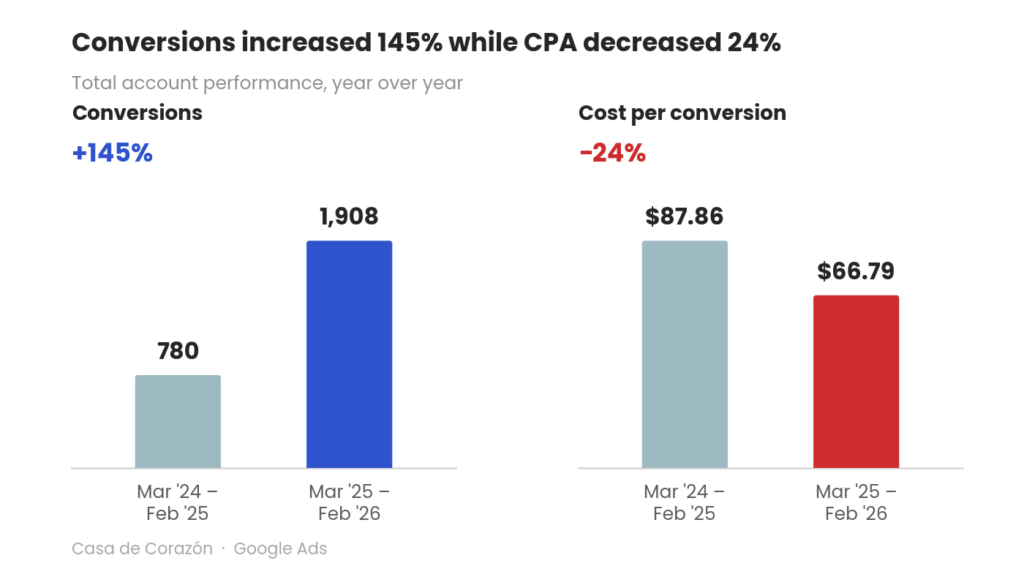
That was Casa de Corazón's Google Ads account when we took it over in early 2025. Twelve months later, inquiries had gone from 780 to 1,908, a 145% increase, at a 24% lower cost per acquisition. The account didn't need more budget to get there. It needed to stop buying the wrong searches.
“Before Uproer, our lead volume could swing dramatically from week to week, which made it difficult to understand what was working. Since partnering with them, we’ve stabilized at our lead goals, increased our year-over-year totals by more than 40%, and built a level of consistency our team can actually plan around.”
Daniel Laux, Director of Marketing
Casa de Corazón runs Spanish immersion early learning daycares across the Twin Cities, Rochester, Madison, and Milwaukee. Four programs: infant, toddler, preschool, and Pre-K. Here's what the account looked like when we opened it, and what we did about it.
The Challenge
Casa's account was organized the way most multi-location accounts are: one broad "enrollment" campaign per location. Each campaign was responsible for advertising every program to every kind of parent in its region. On paper that's tidy. In practice, it means every campaign has to say everything, so it says nothing well.
The bigger problem was match type. Ninety-two percent of spend ran through broad match keywords like "child care" and "childcare around me." Exact match accounted for barely one percent.
Broad match at that scale bought a lot of searches that were never going to convert: competitors' brand names, families looking for free public programs like ECFE and Head Start, job seekers, and neighborhoods well outside any location's service area. Non-converting queries consumed $25,906, or 69% of all visible search-term spend.
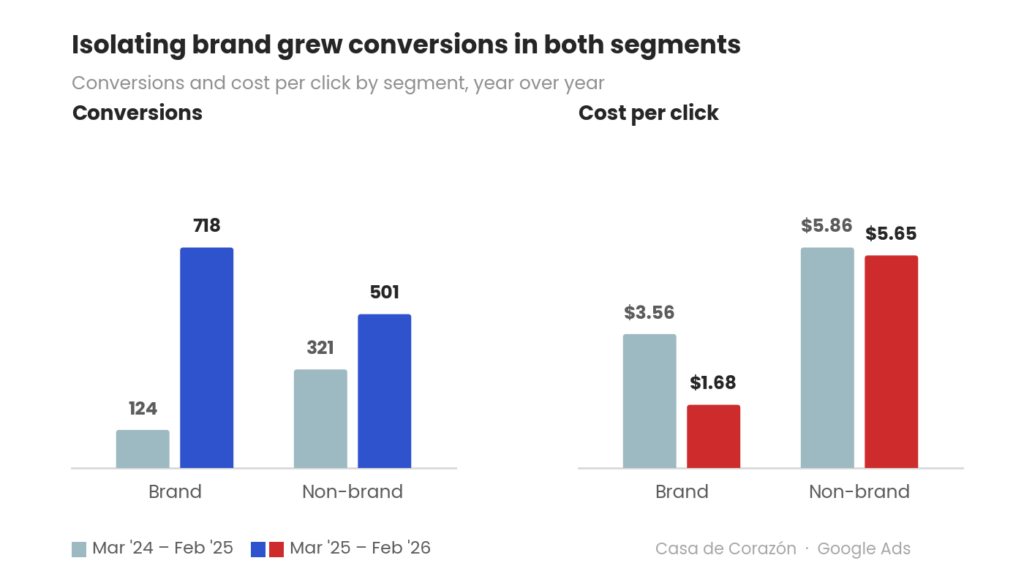
Broad match was also swallowing Casa's own brand searches. There was $5,542 in branded spend with no dedicated brand campaign to receive it, $2,063 of which converted zero times. "Casa de corazón near me" pulled 557 clicks and converted at 1.8%, because a parent searching for the daycare by name got routed to whichever location campaign happened to win the auction and landed on a page that wasn't the one they were looking for.
Meanwhile search impression share sat at 13.81%. For most of the searches that actually mattered, Casa wasn't there at all.
None of this gets fixed by adding budget or writing better ad copy. The account needed to be taken apart and rebuilt around what parents were actually searching for.
Step 1: Separate brand from non-brand and stop the leak
Branded and non-branded traffic behave nothing alike. A parent typing "Casa de Corazón" already knows who Casa is and is close to enrolling. A parent typing "infant daycare near me" has never heard of them. Put those two in the same campaign and every number you look at is an average of two unrelated things. You end up making budget decisions on a blend that describes neither one.
We paused the location campaigns and launched replacements with brand isolated in a campaign of its own. Branded searches now had somewhere to land, pointed at the right pages, instead of getting caught by accident. It also meant we could finally see non-brand performance on its own terms.
The reporting got honest, and the budget conversations that followed were about actual acquisition instead of a number propped up by people who were already looking for Casa by name.
Step 2: Rebuild on tight match types with aggressive negatives
Broad match is a reasonable tool when an account has strong conversion data and clear signals to learn from. It's a liability when it's running 92% of spend and teaching itself from noise.
We relaunched on phrase and exact match, then built out more than 200 negative keywords to cut the categories that were burning the budget: competitor names, free-program searches like ECFE and Head Start, out-of-area queries, and job seekers looking for work at a daycare rather than a place for their child. Tedious work. It's also the part most accounts skip, and it's where a big share of that $25,906 was going.
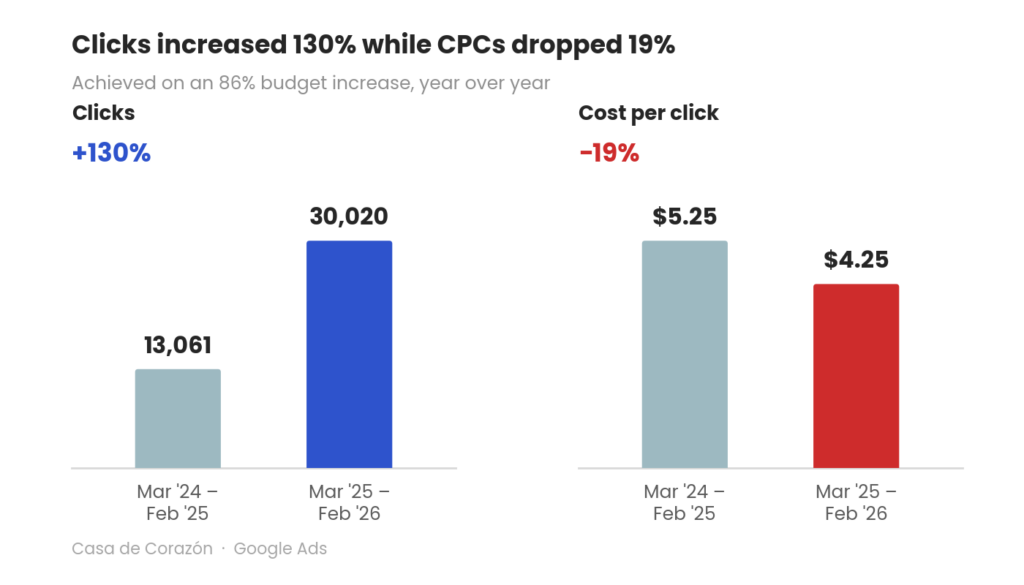
Two numbers then moved in opposite directions, which is the tell that it worked. Clicks rose 130%, from 13,061 to 30,020, on an 86% budget increase, at a 19% lower cost per click.
Casa was buying more traffic, and cheaper traffic, because it stopped paying for searches that were never going to become an enrollment.
Step 3: Restructure around programs instead of locations
One parent is solving a logistics problem with a nine-month-old. Another is making an educational choice about immersion schooling. They type different things into Google, and "infant daycare near me" and "Spanish immersion preschool" deserve different ads. Location-based campaigns couldn't speak to either one well, because every daycare offered every program, so every campaign had to cover all of it.
We collapsed the location campaigns into six built around what families were actually searching for: Infant, Toddler, Preschool, Pre-K, Spanish Immersion, and General Daycare. Each one could now match a single intent with messaging written for it.
Proximity targeting around each daycare kept impressions inside a family's realistic commute, so the structure change didn't cost us local relevance. A parent in Rochester searching for infant care still saw the Rochester location. But, they now saw an ad specifically about infant care.
The Results
Twelve months after the restructure:
- 145% increase in inquiries, from 780 to 1,908
- 24% lower cost per acquisition
- 739% increase in phone calls, from 139 to 1,166, a channel that drives a large portion of childcare enrollments
- 130% increase in clicks, from 13,061 to 30,020, on an 86% budget increase
- 19% lower cost per click
- Search impression share up from 13.8% to 17.2%
Look at the phone calls. Growing calls more than eightfold means the account stopped generating activity and started generating conversations with families ready to enroll.
Casa's team felt it before the reports confirmed it. "Total leads are way more consistent," Daniel told us in a quarterly review. "We've never been this consistent with traffic and leads."
Is a poor account structure throttling your Google Ads results?
If your paid search account is spending more each quarter without moving the business, the answer usually isn't a bigger budget or a new ad variant. It's structure. Casa's account was built around how the company is organized, by location, instead of how parents search, by what their child needs. Fixing that mismatch was worth more than doubling the budget would have been.
If your account has the same problem, we can find it. Book an intro today.