If you sell products online, you already know how much a page title can make or break a click. It's the first thing a searcher sees on Google. If it doesn't tell them what the product actually is, they scroll right past it. That's the exact problem we found on Tradehome Shoes' product pages.
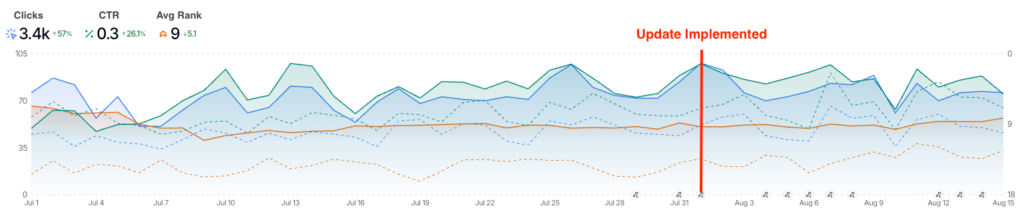
Tradehome Shoes came to us with thousands of product pages whose titles didn't mention what type of shoe they were selling. No "running shoes," no "boots," no "sandals," just brand and model names that meant very little to someone searching Google. The performance trend on those pages was heading the wrong way. And with thousands of SKUs across dozens of brands, hand-editing every title wasn't a realistic fix. We built a system that solved it permanently. In the six weeks since we launched the automated page title tactic, Tradehome Shoe's product pages have pulled in 56% more organic clicks than the same period last year.
Product Page Click Performance YoY

The Challenge
Tradehome Shoes sells a wide range of footwear across a large, constantly changing product catalog, and their product pages are where that catalog meets Google search. If you've ever managed ecommerce SEO at scale, you know the tension here: the fixes that actually move the needle, like rewriting page titles, are also the ones nobody has time to do one page at a time.
That was Tradehome Shoes' exact bind. Their product page titles were missing the one piece of information a searcher needs most: what kind of shoe is this? A title that reads "Timberland Davis Square" tells Google and searchers a lot less than one that reads "Men's Timberland Davis Square Boots." Multiply that gap across thousands of live SKUs, and it adds up to a lot of missed clicks, especially as competitors' listings did a better job spelling out product type.
The trend line made the urgency clear. In the first half of 2026, organic clicks to Tradehome Shoes' product pages were down -13.7% year over year, even as the rest of the site's search visibility was growing. Whatever was dragging on these pages wasn't a one-off dip. It needed a fix that could scale across the entire catalog without turning into a permanent manual task for the Tradehome Shoes team.
The Steps
1. Diagnosing the gap at the page level
Before touching anything, we pulled apart what was actually showing up in search results for Tradehome Shoes' product pages. The pattern was consistent: titles built from brand and model name alone, with no mention of category. Shoppers searching for "men's slip resistant boots" or "waterproof hiking boots" had no way of knowing from the search result that Tradehome Shoes carried exactly what they wanted. It's an easy problem to miss. The pages look fine in a browser, and brand and model are still useful information. But it's the kind of gap that only shows up when you look at the page the way Google and searchers actually see it.
2. Building title logic instead of editing titles by hand
This is the part of the fix that made it durable. Rather than rewrite thousands of individual titles, we built logic that pulls directly from Tradehome Shoes' existing Shopify product data (brand, model, gender, product type) and assembles an SEO-optimized title automatically. Every product already had this information sitting in its Shopify fields; it just wasn't making it into the page title. Our logic reads those fields and builds the title format on the fly, which means the fix works the same way whether Tradehome Shoes has 3,000 products live or 30,000.
3. Applying the page title automation across every product page
Once the logic was built, we applied automated page title logic site-wide across Tradehome Shoes' product pages. New products that get added to the catalog inherit the same optimized title format the moment they go live, with no request needed from Tradehome Shoes' team and no separate SEO pass required before launch. That's the difference between a fix and a fix that keeps working: this one applies itself.
4. Keeping room for manual control where it matters
Automation only works long-term if it doesn't box the client in. For the handful of pages where Tradehome Shoes wants a specific, hand-written title, whether for a seasonal push or a page they're testing, that option still exists. We built in the ability to override the automated logic page by page without breaking it everywhere else. Tradehome Shoes gets the scale of automation and the control of manual editing, without having to choose between them.
The Results
Since launching the new title logic on July 1, 2026, Tradehome Shoes' product pages have turned a decline into growth:
- 57% increase in organic clicks to product pages (3,682 vs. 2,297) comparing July 1 to August 15, 2026, to the same window in 2025
- Average position improved from 14.1 to 8.9 for product pages over that same period
- Click-through rate rose from 0.26% to 0.33%, meaning more of the searchers who see Tradehome Shoes' product pages are actually clicking them
- This reversed a -13.7% year-over-year decline in product page clicks that Tradehome Shoes was seeing in the first half of 2026
The titles aren't just ranking better. They're converting more of the visibility they get into clicks, and that's the part that actually matters for a retailer's bottom line.

Wrap-Up
Page titles are one of the most overlooked levers in ecommerce SEO, mostly because fixing them at scale feels impossible without a small army of copywriters. Tradehome Shoes' story shows there's a better way: build the logic once, let it apply itself to every page automatically, and keep a manual override on hand for the pages that need a human touch. It's a six-week window, not a full year of data, but it's already the mirror image of where these pages started 2026.
If your product pages are quietly costing you clicks and the idea of manually rewriting thousands of titles makes your stomach turn, we've been exactly where you are. Book an intro today and let's talk about what an automated fix could look like for your catalog: https://uproer.com/book-an-intro/