For the past two decades, digital advertising has followed a predictable formula: platforms launch new inventory, marketers learn the rules, and optimization frameworks quickly follow.
ChatGPT Ads are breaking that pattern.
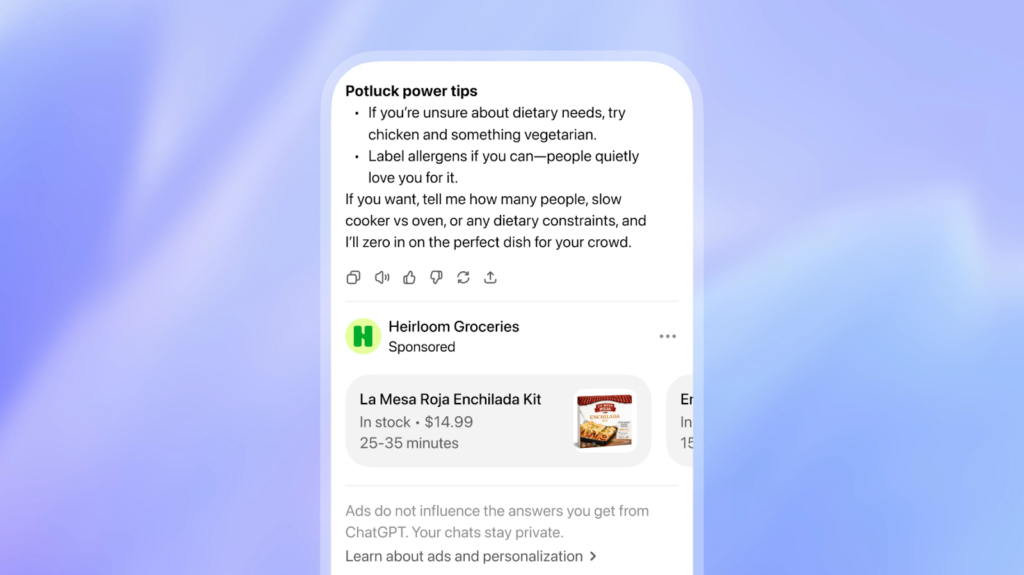
Early sightings show sponsored placements embedded directly inside conversational responses, often appearing alongside informational answers where users aren’t explicitly looking to buy. At the same time, almost nothing is publicly known about how these ads are targeted, ranked, or measured.
That combination, aggressive placement with limited transparency, creates a new challenge for marketing leaders. The question isn’t simply whether ChatGPT ads will perform. It’s how marketers should operate in a system where the rules haven’t been defined yet.

Ads Inside Answers Change the Context of Advertising
Traditional digital ads are clearly separated from content.
Search ads sit above organic results. Social ads interrupt feeds. Display ads surround articles. In most cases, users are able to distinguish the ad from the information they came for.
Conversational ads blur that boundary.
Early examples show ads appearing within the AI’s response itself, often integrated into informational answers rather than purely commercial queries. Instead of responding to explicit purchase intent, the system may surface sponsored options while a user is researching, learning, or exploring a topic.
This shifts advertising from capturing demand to influencing interpretation.
And because the response is generated dynamically, the ad placement feels less like a traditional slot and more like a contextual recommendation, whether users perceive it that way or not.
This shift also introduces a parallel challenge for marketers: visibility inside AI-generated answers isn’t limited to paid placements. As conversational platforms become a primary way people research topics, brands also need to think about how their expertise appears organically within those responses. This emerging discipline, often called Generative Engine Optimization (GEO), focuses on helping AI systems surface credible sources, brands, and insights when generating answers. For teams trying to understand how to influence both paid and organic visibility in conversational environments, GEO is quickly becoming an important part of the strategy.
The Real Challenge: We Don’t Know the Rules Yet
What makes ChatGPT ads especially unusual is how little the industry currently knows about how they work.
Key mechanics remain unclear:
- How targeting is determined
- What signals influence placement or ranking
- How conversational context affects eligibility
- How pricing or auctions operate
- How performance will ultimately be measured
For marketers used to more information from platforms like Google Ads or Meta, this level of ambiguity is uncomfortable.
But it’s also typical of early-stage advertising ecosystems. The difference here is that the ad environment itself, conversational AI, is far more complex than previous platforms.
Instead of matching keywords or audience segments, these systems interpret meaning, context, and intent in real time. That makes traditional optimization frameworks harder to apply from day one.
In other words, the uncertainty isn’t a bug of the platform launch. It’s a feature of the technology itself.
What This Means for Marketing Leaders
1. Expect the funnel to shift upward.
Because ads can appear inside informational conversations, conversational platforms may influence decisions earlier in the buying journey than traditional search ads.
2. Plan for measurement ambiguity.
At least initially, attribution models will lag behind user behavior. Marketers should expect gaps between influence and measurable performance.
3. Treat early adoption as intelligence gathering.
For early adopters of ChatGPT Ads, the approach will be less about efficiency and more about learning: how conversational contexts affect engagement, how users respond to integrated recommendations, and where these placements actually influence decisions.
Marketing in the Age of Ambiguity
ChatGPT Ads aren’t just introducing a new inventory source. They’re introducing a new level of uncertainty into digital advertising.
Placements are embedded inside answers. Targeting and auction mechanics remain opaque. Measurement frameworks are still emerging.
For marketers used to operating with dashboards full of precision metrics, that ambiguity can feel uncomfortable.
But historically, the brands that benefit most from new platforms aren’t the ones who wait for perfect clarity, they’re the ones willing to learn while the rules are still being written.
If your team is thinking about how conversational platforms will reshape digital advertising and how to experiment before the market catches up, we’d love to talk.