Healthcare companies often face stiff competition in driving organic search traffic. For one healthcare software company, this challenge was particularly daunting as they had previously focused their SEO efforts almost entirely on providers. With the launch of new pages targeting patients, the company needed to capture highly localized search traffic and overcome the competition in both large and small markets.
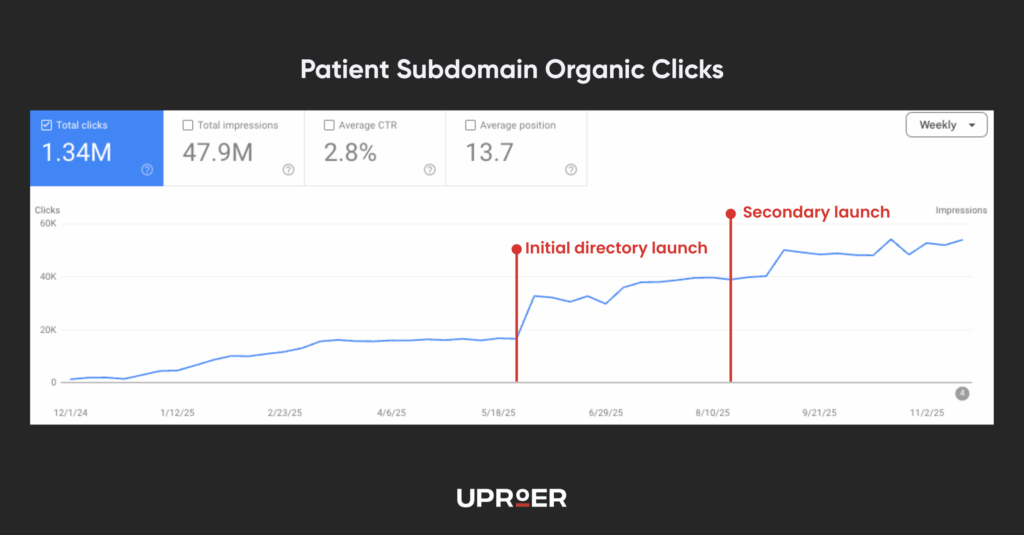
Through a targeted, phased programmatic SEO strategy, we successfully optimized thousands of pages for geographic locations and specialties. The result? A 349% increase in clicks and 362% increase in impressions.
The Challenge
The healthcare software company had largely invested in SEO targeting healthcare providers, but the launch of their provider directory targeting patients marked their first foray into this new SEO territory. The challenge was clear: they needed to drive traffic to a new set of pages with a highly localized focus, while competing with both large national players and smaller local competitors.
As the company expanded its SEO efforts into a new market, the sheer number of geographic locations, specialties, and other search parameters made it critical to create an efficient, scalable plan. Without this, the risk of getting lost in a sea of pages was high, and targeting the right areas would require careful balancing of search volume and competition.
Step 1: Extensive Keyword Research & Phased Strategy
The first critical step in our strategy was identifying which keywords to target. Our client faced the dual challenge of tapping into both high-volume, competitive keywords and more niche, less competitive ones. Using search volume and competition as guides, we initially focused on location terms, which had the largest search volume opportunity.
We prioritized geographic locations that had high search volume while balancing this with areas where competition was lower. Once this phase was complete, we used the same approach to target specialty pages, ensuring that they covered a variety of healthcare specialties in a strategic way. This method allowed us to efficiently focus on areas with high ROI potential.
Key Phase Breakdown:
- Phase 1: Launched with ~1,000 geographic locations, prioritized by search volume and competition.
- Phase 2: Targeted ~12 specialties for each state, continuing the focus on less competitive areas.
- Phase 3: Expanded to include another ~1,000 cities, ensuring that we gradually scaled while maintaining efficiency.
Step 2: Technical Foundation for Crawlability
With any enterprise SEO project, ensuring that search engines could crawl and index the new pages effectively was crucial. We focused on technical SEO tactics to enhance crawl efficiency and indexation. Given the sheer number of pages, crawl budget became a key consideration.
To address this:
- We used server-side rendering to ensure critical content was easily accessible to search engines.
- We created segmented XML sitemaps to guide search engines through the vast number of pages.
- We incorporated pagination to better manage large sets of content and avoid crawling bottlenecks.
These technical steps made sure that the website’s SEO performance remained strong, even as the volume of pages grew significantly.
Step 3: On-Page Optimization for Scalability
With keyword research and technical foundation in place, we turned to optimizing individual pages for maximum SEO performance. On-page tactics played a significant role in driving visibility.
To improve crawlability and user experience, we included internal linking modules that connected related city pages within the same state. This helped both search engines and users navigate the site more efficiently, promoting the spread of link equity across the pages.
By identifying the most common keyword structures, we created a formulaic way to scale the creation of content for thousands of locations and specialties. We also ensured that foundational on-page elements, such as metadata, headings, and internal linking, were consistent, allowing for a highly scalable SEO strategy.
The Results
The initial results were encouraging. Within the first month, we saw top 3 rankings in smaller, less competitive markets. As the pages matured, our client moved into more competitive regions and began seeing substantial results.
Today, the healthcare software company ranks in the top 10 for core search terms like "find _ near me," reflecting the success of the targeted approach. The overall results were a 349% increase in clicks and a 362% increase in impressions, showing the direct impact of our programmatic SEO strategy.
What’s Next?
Looking forward, the next phase of this SEO effort will focus on refining crawl efficiency further to ensure that pages are properly indexed and ranked. Once this is achieved, the focus will shift to new areas, including targeting provider/patient identities, and expanding the SEO efforts even further. SEO is never a one-and-done
By taking a structured, scalable approach to programmatic SEO, the healthcare software company was able to overcome challenges in an untapped market and achieve impressive results. Their success serves as a testament to the power of balancing technical expertise, strategic keyword research, and scalable content optimization.
Want to learn more about how we approach enterprise SEO to drive results? Let’s talk.